Save to shopping list
Create a new shopping list
DJI Dock 4 + DJI Matrice 5TD – Automated Docking Station with Thermal Imaging Drone   Kopiuj
New in

DJI Dock 4 + DJI Matrice 5TD – Automated Docking Station with Thermal Imaging Drone Kopiuj

Regular price net gross / szt.
20 359,72 €
net / szt.
25 042,46 €
gross / szt.
14 days for easy returns
This product is not available in a stationary store
Safe shopping
Product sold out
You will receive an email notification from us when the product is available again.
Data is processed in accordance with the privacy policy. By submitting data, you accept privacy policy provisions.
Contact details entered above are not used to send newsletters or other advertisements. When you sign up to be notified, you hereby agree to receive only a one-time notification of a product re-availability.
Warranty
DJI Dock 4 and DJI Matrice 5TD – automated drone operations system

DJI Dock 4 + DJI Matrice 5TD – Automated Drone System with Thermal Imaging

DJI Dock 4 with DJI Matrice 5TD is an integrated DJI Enterprise system designed for automated inspections, patrols and rapid incident assessment. The dock automatically swaps batteries in under 25 seconds, while Matrice 5TD combines three visible-light cameras, thermal imaging, a laser rangefinder and advanced obstacle sensing. Remote flight planning, monitoring and data analysis through DJI FlightHub 2 support routine operations without requiring a pilot on site at the dock.

Rapid Response Readiness
Versatile Sensor Suite
Built-In Radar Systems
AI-Powered Operations
Integrated Software
Operational Safety

Automatic Battery Swapping in Around 25 Seconds

DJI Dock 4 replaces lengthy on-dock charging intervals with automatic battery swapping. The mechanism completes a swap in around 25 seconds, and the minimum turnaround time between landing and the next takeoff is around 45 seconds. This reduces downtime during patrols, scheduled inspections and missions where the aircraft must be redeployed quickly. These figures are based on controlled DJI tests.

The dock features four battery compartments. Up to three can be occupied at once, leaving one empty so the mechanism can remove and replace the aircraft battery automatically. Dock 4 can charge up to two batteries simultaneously; charging from 15% to 95% takes approximately 27 minutes at 25°C. Battery swapping and power management operate without manual intervention.

Ready to Respond – Dock as First Responder

On command, DJI Matrice 5TD can take off from the dock without a pilot physically present at the station. In FlyTo mode, it can reach speeds of up to 21 m/s, supporting rapid situational awareness and live video delivery to response teams. A maximum flight time of 59 minutes under test conditions also supports extended missions. The system can be deployed as part of a DFR – Drone as First Responder operating model.

DJI Matrice 5TD – Day and Night Observation

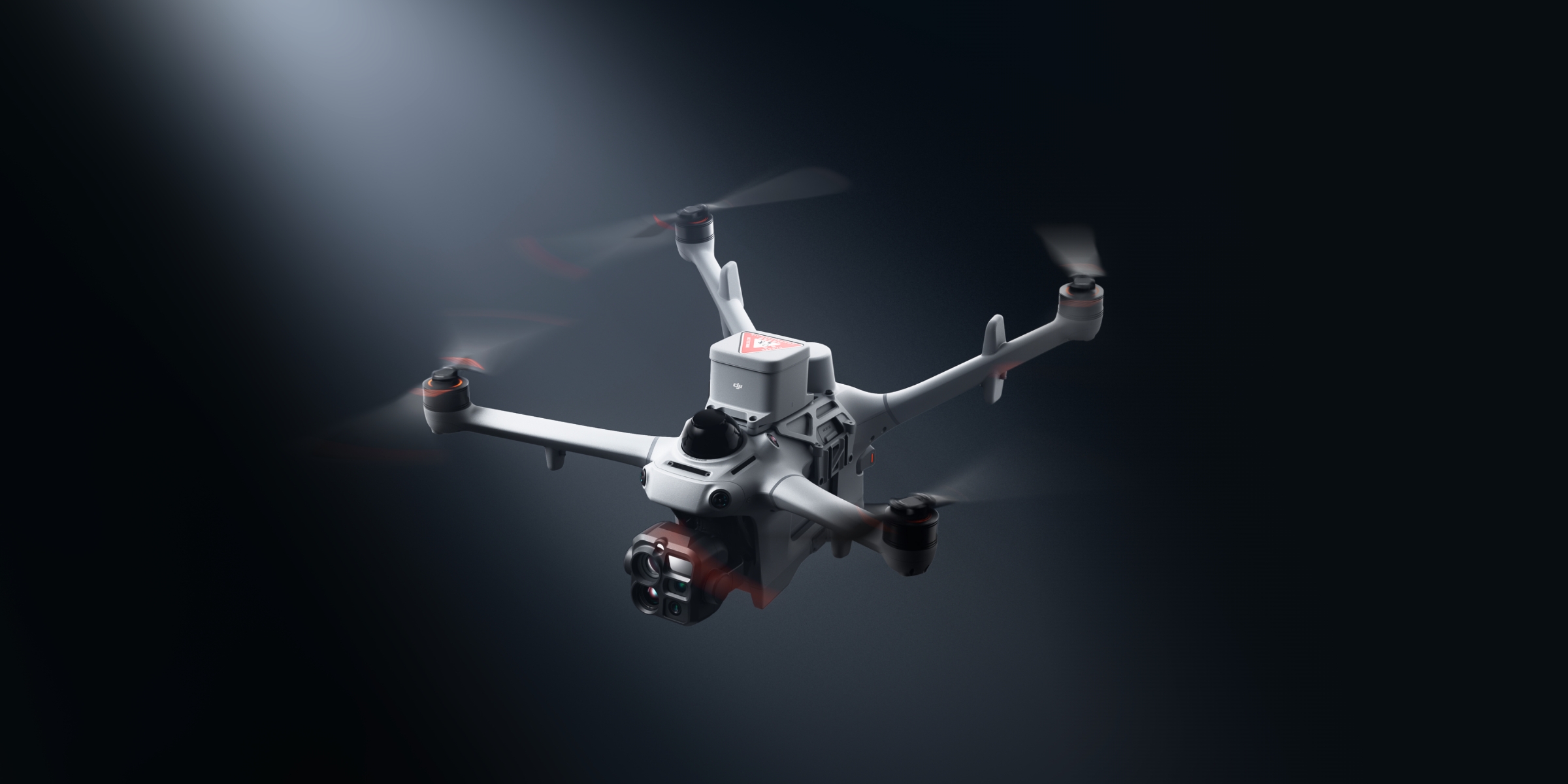
DJI Matrice 5TD is a multisensor enterprise drone designed to operate with DJI Dock 4. Three 50 MP visible-light cameras – wide-angle, medium telephoto and telephoto – provide different views of the scene (35 mm equivalent focal lengths of 23.5, 70 and 252 mm). Operators can move quickly from surveying an entire area to inspecting details of structures, objects and infrastructure.

1280 × 1024 px thermal imaging, with spot and area temperature measurements from −40°C to 550°C depending on the mode, visible/thermal image fusion, additional NIR illumination and night mode support low-light operations. The laser rangefinder measures distances of up to 3,000 m under the conditions specified by DJI. Matrice 5TD also offers up to 59 minutes of flight time, an IP55 rating and built-in RTK, making it suitable for power infrastructure inspections, site monitoring and search-and-rescue operations. Detailed camera, thermal and flight parameters are listed in the specifications below.

The 252 mm equivalent telephoto camera offers approximately 11× magnification relative to the wide-angle camera, helping operators inspect markings and infrastructure details from farther away. Full-colour 4K night vision supports colour imaging in low light, while the integrated NIR illuminator assists black-and-white nighttime observation. The PinPoint function overlays distance and the coordinates of a selected point on the live view, helping teams share accurate locations during field operations.

DJI Matrice 5TD – camera and sensor system for day and night operations

Safer Flight in Complex Environments – LiDAR, Radar and Vision Systems

Matrice 5TD uses 360° rotating LiDAR, forward-, upward- and downward-facing mmWave radar, a six-directional vision system and a downward 3D infrared sensor. Together, these systems support obstacle sensing around electrical substations, power lines and complex structures.

LiDAR has a standard measurement range of up to 110 m, while the forward radar can detect specified types of power lines under DJI test conditions. The sensors support situational awareness in lower light, although their performance depends on the surroundings and weather. Radar availability may vary by region, and obstacle sensing does not replace risk assessment or appropriate operational oversight.

More Payloads, Greater Flexibility

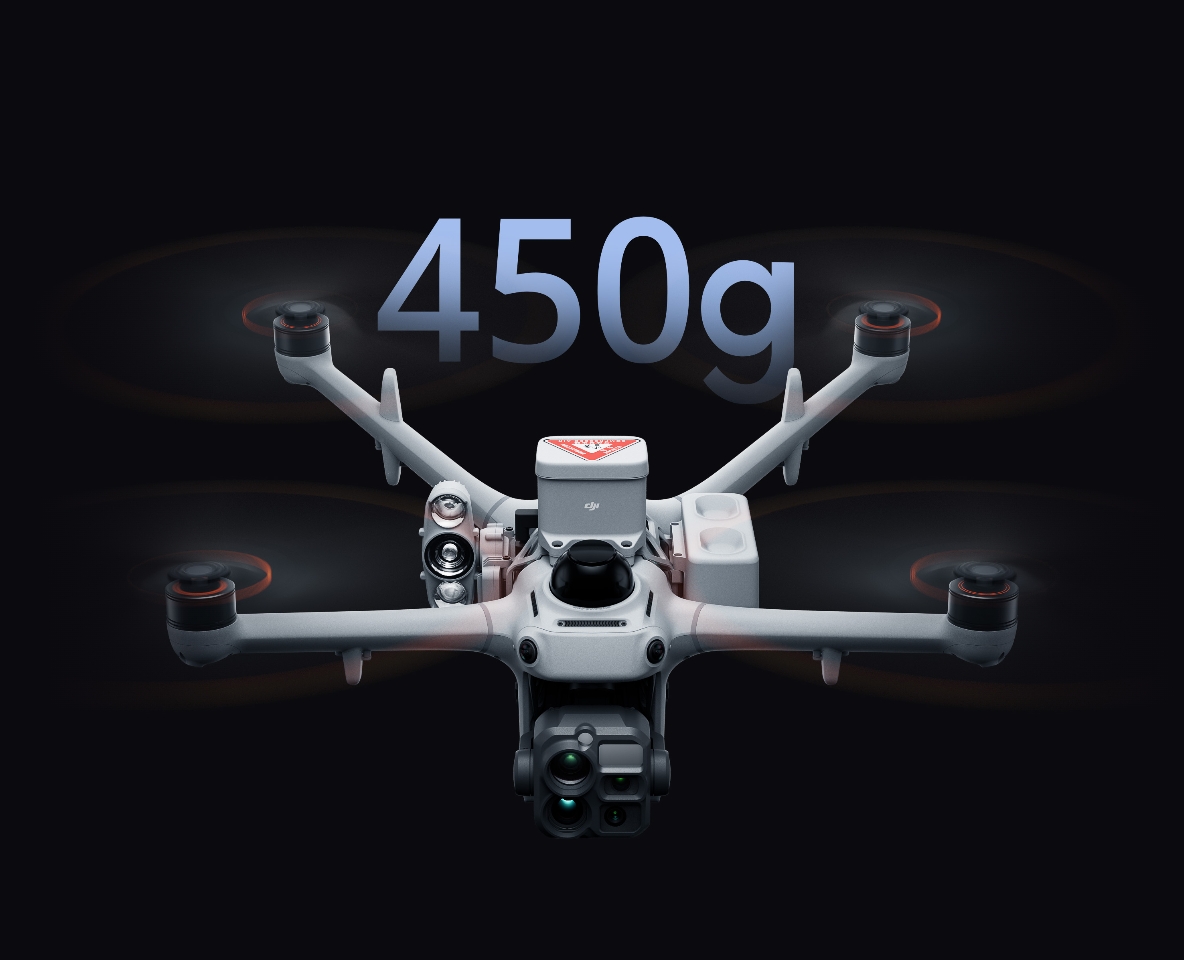
DJI Matrice 5TD provides three accessory mounting positions – two on the sides and one on top – along with E-Port interfaces, allowing the aircraft to be configured for different tasks. It supports compatible equipment with a combined weight of up to 450 g, including an optional spotlight, loudspeaker, DJI AP1 parachute and selected third-party devices such as measurement sensors.

Optional equipment is selected separately, using suitable mounting hardware and checking compatibility. Adding payloads may affect flight time and the availability of certain obstacle-sensing functions. A built-in, configurable warning light improves aircraft visibility during public safety and site security operations.

DJI Matrice 5TD accessories and optional payloads

Rugged Design for Year-Round Operations

The DJI Dock 4 enclosure is rated IP56 and operates at temperatures from −40°C to 50°C. Air conditioning, battery heating and environmental sensors help keep the dock ready for operation in changing weather conditions. Individual flights are still subject to weather limits and safety rules: a weather-resistant dock does not mean unrestricted operation in rain or strong winds.

Flexible Deployment in Challenging Locations

Thanks to the separate DJI O4 Ground Station and DJI positioning solutions, Dock 4 offers greater flexibility in infrastructure planning than systems with fully integrated communications. DJI is developing features for high-rise environments and handovers between docking stations. Vehicle-mounted deployment is planned for the first half of 2027, while deployment near tall buildings is currently subject to regional restrictions. Each site should be assessed before installation.

During return and landing, the system combines RTK positioning, LiDAR and visual SLAM to build a map of the surrounding environment. In the final landing phase, it also identifies visual markers on the Dock 4 landing platform, helping the aircraft position itself accurately for automatic battery swapping.

DJI Dock 4 – flexible deployment in challenging locations

DJI O4 Ground Station – Reliable Connectivity and Data Transmission

DJI O4 Ground Station is a required component of the Dock 4 system. It enables aircraft communication and combines video transmission, RTK and network connectivity. DJI supports sub-2 GHz bands and 4G connectivity where available. Under test conditions, an optimised transmission path can achieve video latency of approximately 160 ms, while high-speed Wi-Fi transfer after landing speeds up the delivery of captured data.

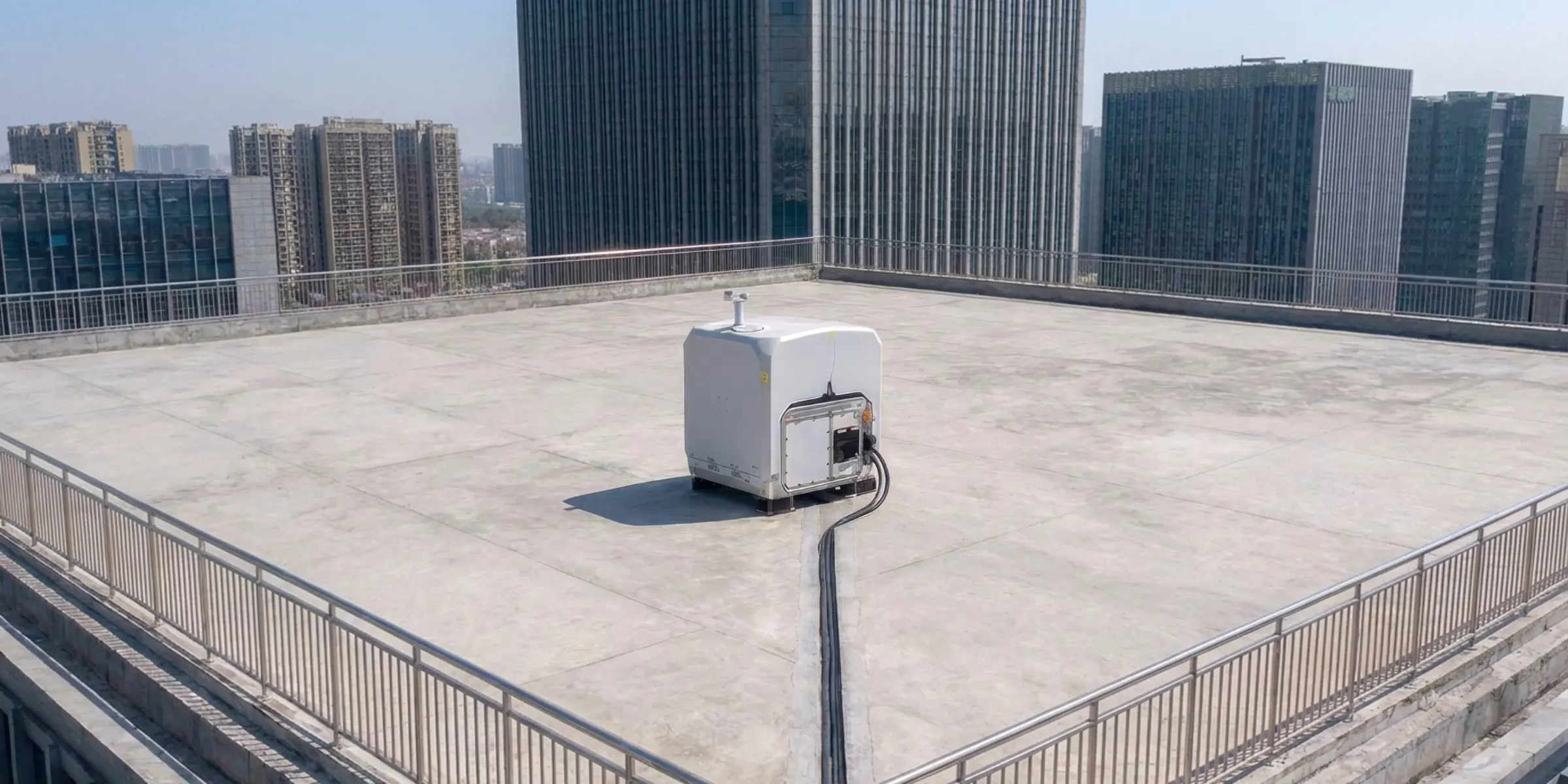
The separate ground station can be mounted in a location with more favourable transmission conditions, for example above nearby obstacles. It has an IP67-rated housing, supports PoE power and cold-weather heating start-up. Deployment planning should account for outdoor-rated Cat 6 or better Ethernet cabling and suitable network performance. Supported radio bands and 4G availability depend on the country and configuration.

DJI Dock 4 and DJI O4 Ground Station – urban deployment

Onboard AI – Recognition of 17 Object Types

DJI Matrice 5TD uses onboard AI algorithms to recognise 17 types of objects during live observation. The system also supports high-temperature hotspot detection and selected third-party AI models. The DJI FlightHub 2 virtual cockpit extends these capabilities with text- or image-based object searches, depending on the supported software version and deployment.

DJI FlightHub 2 – Remote Mission Management and AI Automation

DJI FlightHub 2 is a platform for remotely managing DJI Dock 4 and Matrice 5TD. It lets teams plan routes and schedules for patrols and inspections, send the drone to a selected location, track mission parameters and watch live video through a virtual cockpit. Maps, video streams and device status give operators real-time situational awareness without having to be physically present at the dock.

Automation and DJI FlightHub 2 Copilot help teams create routes and workflows using natural-language instructions. The system can respond to events or signals from external systems, launch missions and send alerts. AI tools support image-based object searches, anomaly identification and incident documentation – useful for site security, utilities and Drone as First Responder (DFR) workflows.

Data analysis and reporting tools enable users to compare new images with earlier records, detect changes in infrastructure or terrain, add annotations and generate reports. Public-cloud deployments, selected on-premises solutions and API integrations are available. AI, automation and reporting features vary according to the DJI FlightHub 2 version and licence.

Depending on the configuration, event-triggered workflows may send notifications, start recording or activate tracking of a selected object. Post-Processing Smart Detection and Change Detection help compare new mission data with older aerial images or 3D models, highlight differences and produce reports. Selected device functions also support remote updates and maintenance.

Flight, Airspace and Data Security

DJI offers measures designed to reduce operational risks, including geofencing, aircraft detection and the optional DJI AP1 parachute with a flight termination system (FTS). With an appropriate configuration, Matrice 5TD equipped with AP1 may meet the technical requirements for C5/C6 classes; this does not automatically authorise BVLOS operations. Data protection measures include encrypted transmission and access controls. Available features must be verified for the chosen configuration and the regulations applicable to the planned operation.

In a suitably configured system, Geocaging defines permitted operational boundaries. Combined with the optional DJI AP1 parachute and FTS, the system can trigger protective measures automatically when the configured boundary is crossed or certain abnormal flight conditions are detected. AirSense/ADS-B and Remote ID information can improve airspace situational awareness; the available functions and data sources depend on the configuration and region.

DJI specifies TLS 1.2+ and AES-256 for protected drone-to-dock data transmission, alongside encrypted connections for cloud uploads. Permission management, access logs and data deletion at device, account or organisation level support information-security requirements in professional deployments.

DJI Dock 4 and Matrice 5TD operational safety

Backup Power and Dock Status Monitoring

If mains power is lost, DJI Dock 4 can use batteries stored in its compartments to maintain selected functions. Under DJI test conditions, one battery provides approximately 4.5 hours of backup operation, with sequential power supply supported. Aircraft charging and the full temperature-control system are unavailable in backup power mode. Sensors and internal and external cameras help monitor the installation.

DJI Dock 4 – docking station and backup power management

DJI Dock 4 Applications in Public Safety and Industry

DJI Dock 4 can support site and perimeter security, power infrastructure monitoring, asset inspections, search operations and emergency response. Scheduled routes help document changes over time, while rapid deployment supports incident response. Each installation should be designed for its intended use, including the dock location, connectivity, integration with control centres, flight procedures and regulatory requirements.

DJI Matrice 5TD for public safety – spotlight, warning lights and loudspeaker

DJI Dock 4 and DJI Matrice 5TD Technical Specifications

DJI Dock 4 – General Specifications

DeviceDJI Dock 4 docking station
Compatible aircraftDJI Matrice 5TD (this model only)
Number of supported aircraft1
Device weight66 kg, excluding batteries stored in compartments and the aircraft
Dimensions, cover closed639 × 640 × 836 mm (L × W × H)
Dimensions, cover open1750 × 640 × 550 mm (L × W × H)
Power supply100–240 V AC, 50/60 Hz
Maximum power consumption2000 W
Operating temperature−40°C to 50°C
Ingress protection ratingIP56
Maximum operating altitude5000 m above sea level
Maximum allowable wind speed during landing12 m/s
Maximum rainfall intensity for normal operation2 mm/h (according to DJI FAQ)
Mounting hole spacing400 × 400 mm
Noise levelBelow 60 dB in Silent mode; 65 dB in Normal mode

Battery Swapping and Charging

Charging methodAutomatic battery swapping and wireless charging
Automatic battery swap timeUnder 25 s (measured from the moment the cover is fully closed)
Turnaround time between flightsUnder 45 s (from landing to the next takeoff)
Number of battery compartments4
Maximum number of batteries in compartments at one time3 (one compartment remains empty)
Parallel charging channels2
Output voltage per channel15–25.8 V DC
Single-battery charging timeApproximately 27 min from 15% to 95% at 25°C

Backup Power and Temperature Management

Backup power sourceAircraft battery stored in a dock compartment
Battery capacity for backup power12,138 mAh
Backup battery voltage21.42 V
Backup operating timeApproximately 4.5 hours per battery under DJI test conditions; sequential backup supply from up to 3 batteries supported
Backup power limitationsAircraft charging, air conditioning and anemometer heating are unavailable
Temperature-control systemCompressor-based air conditioning
Air conditioning operating voltage48 V DC

Environmental Sensors, Cameras and Protection

Environmental sensorsWind speed, rain, ambient temperature, compartment temperature and compartment humidity
External monitoring camera1920 × 1080 px, 151° field of view, auxiliary white light
Internal monitoring camera1920 × 1080 px, 151° field of view, auxiliary white light
AC input surge protection20 kA, EN 61643-11 Type 2 / IEC 61643-1 Class II
Ethernet port surge protection10 kA (Itotal), EN/IEC 61643-21, Category C

Connectivity and Software

Required external unitDJI O4 Ground Station
Video transmissionDJI O4 Enterprise Enhanced via DJI O4 Ground Station
RTK base stationSupported via DJI O4 Ground Station
Network connectivityEthernet via DJI O4 Ground Station
4G connectivityRequires DJI Cellular Dongle 2 connected to DJI O4 Ground Station; availability varies by region
ApplicationDJI Enterprise App
Management platformsDJI FlightHub 2, DJI FlightHub 2 On-Premises, FlightHub Sync, DJI Cloud API

DJI O4 Ground Station – Specifications of the Required Ground Unit

Dimensions170 × 170 × 352 mm
Weight2.68 kg
Ingress protection ratingIP67
Operating temperature with Dock 4 power−40°C to 55°C; DJI installation limitations apply at extreme temperatures
Power supply and start-upEthernet PoE; automatic power-on after supply restoration; cold-weather heating start-up
Video transmissionDJI O4 Enterprise Enhanced; supported frequencies and power vary by region
GNSS/RTKIntegrated GNSS/RTK; calibrated RTK accuracy: 1 cm + 1 ppm horizontally and 3 cm + 1 ppm vertically
Network connectivityEthernet; optional 4G with DJI Cellular Dongle 2 (regional availability applies)
Recommended network performanceGigabit Ethernet; upstream and downstream bandwidth over 20 Mbps, preferably at least 40 Mbps; latency no greater than 100 ms
CablingOutdoor-rated Cat 6 or better Ethernet cable; maximum cable length specified by DJI: 80 m

DJI Matrice 5TD – Technical Specifications

DJI Matrice 5TD – Aircraft and Flight Performance

ModelDJI Matrice 5TD
Weight with battery, propellers and microSD card2600 g (without additional payloads)
Maximum takeoff weight3050 g
Dimensions, excluding propellers393 × 477 × 230 mm
Diagonal wheelbase549 mm
Maximum flight timeUp to 59 min (laboratory conditions, without payload)
Maximum hovering timeUp to 55 min (no wind)
Maximum operating radius10 km (DJI test conditions; not the transmission range)
Maximum flight distance53 km (DJI test conditions; not the maximum mission radius)
Maximum horizontal speed21 m/s in FlyTo missions; 15 m/s in other modes
Maximum ascent / descent speed6 / 6 m/s
Wind resistanceUp to 12 m/s
Maximum takeoff altitude6500 m above sea level without payload; 4500 m at full payload
Maximum tilt angle25° (Normal mode)
Operating temperature−40°C to 50°C
Ingress protection ratingIP55
GNSSGPS, Galileo, BeiDou, QZSS and GLONASS
RTK moduleBuilt in
RTK hovering accuracy±0.04 m vertically; ±0.02 m horizontally
Warning lightBuilt-in, multicolour, configurable
Accessory mounting3 positions: two side mounts and one top mount; up to 450 g of compatible accessories

DJI Matrice 5TD – Visible-Light Cameras

Wide-angle camera1/0.98-inch CMOS, 50 MP; 23.5 mm (equiv.); f/1.8; 85.7° FOV
Medium telephoto camera1/1.28-inch CMOS, 50 MP; 70 mm (equiv.); f/2.88; 35° FOV
Telephoto camera1/1.5-inch CMOS, 50 MP; 252 mm (equiv.); f/2.8; 9.7° FOV
Maximum photo resolution8192 × 6144 px for each of the three cameras
Photo modesSingle shot, interval, Smart Capture; panorama with wide-angle camera
Video4K 3840 × 2160 / 30 fps or Full HD 1920 × 1080 / 30 fps
Video codec and formatH.265, MP4 / TS
Photo formatJPEG
Telephoto digital zoomUp to 16× digital; up to 176× hybrid zoom
Lens defoggingSupported by wide-angle and telephoto cameras
ISOStandard: 100–25,600; Night mode: up to 1,638,400
Stabilisation3-axis mechanical gimbal; controllable tilt range −90° to +90°
Full-Colour Night Vision4K colour imaging in low light; black-and-white nighttime observation supported by NIR illumination

DJI Matrice 5TD – Thermal Imaging and Laser Rangefinding

Thermal sensor typeUncooled VOx microbolometer
Thermal resolution1280 × 1024 px (sensor); UHR mode: images up to 2560 × 2048 px
Frame rate30 Hz
Pixel pitch8 μm
Thermal focal length53 mm (equiv.), f/0.85; 45° DFOV
Thermal sensitivity≤50 mK (@ f/1.0 and 25°C)
Temperature measurement rangeHigh Gain: −40°C to 150°C; Low Gain: 0°C to 550°C
Temperature measurement accuracyHigh Gain: ±2°C or ±2%; Low Gain: ±5°C or ±3% – whichever is greater
Temperature measurement modesSpot and area measurement; temperature alerts
Thermal digital zoomUp to 32×
Visible and thermal imagingImage fusion supported
Thermal image formatsJPEG, R-JPEG (16-bit), DLT-664
Thermal video1280 × 1024 / 30 fps; UHR up to 2560 × 2048 / 30 fps
Auxiliary NIR illuminationBuilt in; 5.2°–6.6° field of view
Laser rangefinderUp to 3000 m at normal incidence and with specified target characteristics; Class 1 laser
Laser rangefinder – oblique measurementUp to 1200 m under conditions specified by the manufacturer
PinPointShows measured distance and coordinates of the selected point on the live image

DJI Matrice 5TD – Obstacle Sensing

Sensing systemSix-directional vision system, rotating LiDAR, downward 3D IR sensor, and forward-, upward- and downward-facing mmWave radar
Forward vision systemMeasurement: 0.5–25 m; detection up to 200 m; 95° × 90° FOV
Rear and side vision systemsMeasurement: 0.5–25 m
Upward and downward vision systemsMeasurement: 0.5–20 m
LiDAR – type and range360° rotating LiDAR, up to 110 m under conditions specified by DJI
LiDAR – field of view360° horizontal, 59° vertical
LiDAR – measurements250,000–460,000 points/s; 940 nm wavelength; Class 1 laser
Downward 3D infrared sensor0.3–8 m
mmWave radar – directionsForward, upward and downward (regional restrictions may apply)
mmWave radar – power line testsUp to 40 m in front of the aircraft; up to 20 m above or below for the cable specified in DJI tests

DJI Matrice 5TD – Transmission and Battery

Transmission systemDJI O4 Enterprise Enhanced
Maximum transmission range (CE)12 km without obstacles or interference; actual conditions may reduce the range
Live view via DJI Dock 41080p / 30 fps
Minimum latency to FlightHub 2Approximately 160 ms (DJI test conditions)
Post-landing data transferUp to 80 MB/s via high-speed Wi-Fi under favourable conditions
Battery capacity12,138 mAh
Energy and voltage260 Wh; 21.42 V
Cell chemistryLi-ion 6S (LiNiMnCoO₂)
Battery weight925 g
Cycle lifeUp to 400 cycles under manufacturer-specified conditions
Charging temperature10°C to 55°C; low-temperature charging with self-heating
Storage mediamicroSD cards rated U3 / Class 10 / V30 or higher

Technical specifications and flight times are based on DJI tests and are not guaranteed for every mission. The maximum speed of 21 m/s applies to FlyTo mode. Power line detection and mmWave radar are subject to environmental and regional limitations; enabling an additional spotlight disables vision-based obstacle sensing. Vehicle mounting is planned for the first half of 2027, while high-rise deployments may have regional availability restrictions. Dock 4 requires DJI O4 Ground Station and is compatible only with DJI Matrice 5TD. Aircraft safety features and technical classification do not automatically authorise BVLOS operations. Availability and the exact equipment package must be confirmed for the relevant SKU and market.

DJI Dock 4 and Matrice 5TD – Frequently Asked Questions

What Is Included in the DJI Dock 4 and Matrice 5TD Offering?

This product page covers a DJI Dock 4 docking station and DJI Matrice 5TD aircraft. The exact battery count, accessories, licences and inclusion of the required DJI O4 Ground Station must be confirmed for the specific product variant.

Which Drone Is Compatible with DJI Dock 4?

DJI Dock 4 is compatible exclusively with DJI Matrice 5TD. Earlier DJI Matrice 4D and Matrice 4TD aircraft are not compatible with this dock.

How Long Does a DJI Dock 4 Battery Swap Take?

According to DJI, a battery swap takes less than 25 seconds, and the interval from landing to the next takeoff can be less than 45 seconds. These figures are based on controlled testing.

How Many Batteries Can DJI Dock 4 Hold?

The dock has four compartments, but normally no more than three can be occupied at the same time. One compartment must remain empty for automatic battery swapping.

Does DJI Dock 4 Require DJI O4 Ground Station?

Yes. DJI O4 Ground Station is essential for DJI Dock 4 operation. Among other functions, it provides video transmission, RTK and network connectivity.

Can DJI Dock 4 Operate During a Power Outage?

During a mains power outage, the dock can use batteries stored in its compartments, but aircraft charging and some other system functions are unavailable.

Does DJI Dock 4 Allow BVLOS Flights Without Additional Authorisations?

No. The system's technical capabilities and aircraft class do not replace a risk assessment, the appropriate operational authorisation or other regulatory requirements for the specific mission.

What Can DJI Dock 4 Be Used For?

It is suitable for remote inspections and patrols, power and industrial infrastructure monitoring, site security and support for search-and-rescue and public safety operations.

Can DJI Dock 4 Be Mounted on a Vehicle?

DJI plans to introduce mobile mounting support in the first half of 2027. This is not yet a standard, ready-to-use option; once available, it will require appropriate mounting hardware, and the vehicle must be stationary during operations.

Does DJI Matrice 5TD Have LiDAR and Radar for Power Line Detection?

Yes. The aircraft has rotating LiDAR, mmWave radar and a six-directional vision system. Performance depends on environmental conditions, and radar functions may have regional availability restrictions.

Which Accessories Does DJI Matrice 5TD Support?

DJI specifies support for compatible accessories weighing up to 450 g in total, mounted on two side positions and one top position. Availability and simultaneous installation depend on the selected configuration and mounts.

Does DJI Dock 4 Support AI Functions?

Yes. Onboard AI recognises 17 types of objects, while DJI FlightHub 2 supports image analysis, alerts and automated workflows. Individual features depend on software, deployment and region.

Are DJI Dock 4 and Matrice 5TD Eligible for DJI Care Enterprise Plus?

Yes. DJI offers DJI Care Enterprise Plus for Dock 4 and Matrice 5TD, and advertises first-year coverage on its launch website. Services may include repairs and technical support, with selected battery and Flyaway-related benefits for the aircraft. Regional availability, activation requirements, applicable coverage and any costs in Poland must be confirmed for the specific sales package and deployment. These statements do not imply that all benefits are unconditionally included with every SKU.

-
-
Do you need help? Do you have any questions?Ask a question and we'll respond promptly, publishing the most interesting questions and answers for others.
Ask for this product
If this description is not sufficient, please send us a question to this product. We will reply as soon as possible. Data is processed in accordance with the privacy policy. By submitting data, you accept privacy policy provisions.
Write your opinion
Your score:
5/5
Add a picture:

Guide

DJI Dock 4 vs Dock 3 and Dock 2 – Detailed Comparison, New Features & FAQ
How have DJI's automated docking stations evolved, and what makes DJI Dock 4 different? Explore a detailed comparison of three generations, discover the key differences between Matrice 5TD, 4TD, 4D and 4T, and learn when upgrading makes sense. Our comprehensive guide covers technical specifications, operational capabilities and 72 frequently asked questions about DJI Dock systems.
View more
pixel